
300 mg (two 150-mg tablets) taken orally twice daily, with or without food (total 600 mg daily)
Select from topics on the page.
REVIEW IMPORTANT SAFETY INFORMATION BELOW.


Select from topics on the page.
REVIEW IMPORTANT SAFETY INFORMATION BELOW.
Select from topics on the page.
Review important safety information below.
The recommended daily dose of LYNPARZA is: 300 mg (two 150-mg tablets) taken orally twice daily, with or without food (total 600 mg daily)


Tablets shown are not actual size.


Consider dose interruption if a patient experiences an AR
See the complete Prescribing Information for detailed dose interruption instructions for select ARs
Following dose interruption, consider dose reduction if a patient experiences an adverse reaction after restarting LYNPARZA

INITIAL REDUCTION
Initial reduction to 250 mg (one 150-mg tablet and one 100-mg tablet) taken twice daily (total 500 mg daily)

FURTHER REDUCTION
Further reduction to 200 mg (two 100-mg tablets) taken twice daily (total 400 mg daily)
SOLO-1 SOLO-2
| Discontinuations | Dose Reductions | Dose Interruptions | ||||
| LYNPARZA | Placebo* | LYNPARZA | Placebo* | LYNPARZA | Placebo* | |
| SOLO-1 | 12% | 2% | 28% | 3% | 52% | 17% |
|---|---|---|---|---|---|---|
| SOLO-2 | 11% | 2% | 27% | 3% | 45% | 18% |
| Study 19 | 6% | 2% | 26% | 4% | 35% | 10% |
ARs were usually managed by dose interruption or dose reduction, rather than by discontinuation.2
| SOLO-1 | SOLO-2 |
|---|---|
| Median time to first onset of the most commonly reported nonhematologic ARs (nausea, fatigue/asthenia, vomiting) and hematologic ARs (anemia, neutropenia, thrombocytopenia) was <3 months in the olaparib arm | Most common ARs occurred within the first month of treatment |
| SOLO-1 | Median time to first onset of the most commonly reported nonhematologic ARs (nausea, fatigue/asthenia, vomiting) and hematologic ARs (anemia, neutropenia, thrombocytopenia) was <3 months in the olaparib arm |
|---|---|
| SOLO-2 | Most common ARs occurred within the first month of treatment |
| Study 19 | Most common ARs occurred within the first 2 months of treatment |
PAOLA-1
The recommended daily dose of LYNPARZA is:
300 mg (two 150-mg tablets) taken orally twice daily, with or without food (total 600 mg daily)
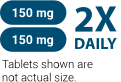

Consider dose interruption if a patient experiences an AR.
See the complete Prescribing Information for detailed dose interruption instructions for select ARs

Consider dose reduction if a patient experiences an AR.
INITIAL REDUCTION
Initial reduction to 250 mg (one 150-mg tablet and one 100-mg tablet) taken twice daily (total 500 mg daily)
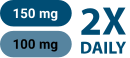
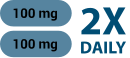
FURTHER REDUCTION
Further reduction to 200 mg (two 100-mg tablets) taken twice daily (total 400 mg daily)
*Continue treatment until disease progression, unacceptable toxicity, or completion of 2 years of treatment. Patients with a CR (no radiological evidence of disease) at 2 years should stop treatment. Patients with evidence of disease at 2 years, who in the opinion of the treating HCP can derive further benefit from continuous treatment, can be treated beyond 2 years. Dose interruptions, reductions, and discontinuations may also occur.1
If a dose of LYNPARZA is missed, the next normal dose should be taken at its scheduled time
Please refer to the bevacizumab package insert for more information on the management of ARs related to bevacizumab and bevacizumab dose adjustments.
Per PAOLA-1 protocol
Per FDA-approved label
| LYNPARZA component | Placebo component | |
|---|---|---|
| LYNPARZA + bevacizumab (n=535) | Placebo + bevacizumab (n=267) | |
| Dose interruptions due to ARs (%) | 54 | 24 |
| Dose reductions due to ARs (%) | 41 | 7 |
| Discontinuations due to ARs (%) | 20 | 6 |
Please refer to the bevacizumab package insert for more information on the management of ARs related to bevacizumab and bevacizumab dose adjustments.
Explore Related Content

LYNPARZA is a poly (ADP-ribose) polymerase (PARP) inhibitor indicated:
For the maintenance treatment of adult patients with deleterious or suspected deleterious germline or somatic BRCA-mutated (gBRCAm or sBRCAm) advanced epithelial ovarian, fallopian tube, or primary peritoneal cancer who are in complete or partial response to first-line platinum-based chemotherapy. Select patients for therapy based on an FDA-approved companion diagnostic for LYNPARZA.
In combination with bevacizumab for the maintenance treatment of adult patients with advanced epithelial ovarian, fallopian tube or primary peritoneal cancer who are in complete or partial response to first-line platinum-based chemotherapy and whose cancer is associated with homologous recombination deficiency (HRD)-positive status defined by either:
Select patients for therapy based on an FDA-approved companion diagnostic for LYNPARZA.
For the maintenance treatment of adult patients with deleterious or suspected deleterious germline or somatic BRCA-mutated (gBRCAm or sBRCAm) recurrent epithelial ovarian, fallopian tube, or primary peritoneal cancer, who are in complete or partial response to platinum-based chemotherapy. Select patients for therapy based on an FDA-approved companion diagnostic for LYNPARZA.
For the adjuvant treatment of adult patients with deleterious or suspected deleterious gBRCAm, human epidermal growth factor receptor 2 (HER2)-negative, high-risk early breast cancer who have been treated with neoadjuvant or adjuvant chemotherapy. Select patients for therapy based on an FDA-approved companion diagnostic for LYNPARZA.
For the treatment of adult patients with deleterious or suspected deleterious gBRCAm, human epidermal growth factor receptor 2 (HER2)-negative metastatic breast cancer who have been treated with chemotherapy in the neoadjuvant, adjuvant, or metastatic setting. Patients with hormone receptor (HR)-positive breast cancer should have been treated with a prior endocrine therapy or be considered inappropriate for endocrine therapy. Select patients for therapy based on an FDA-approved companion diagnostic for LYNPARZA.
For the maintenance treatment of adult patients with deleterious or suspected deleterious gBRCAm metastatic pancreatic adenocarcinoma whose disease has not progressed on at least 16 weeks of a first-line platinum-based chemotherapy regimen. Select patients for therapy based on an FDA-approved companion diagnostic for LYNPARZA.
For the treatment of adult patients with deleterious or suspected deleterious germline or somatic homologous recombination repair (HRR) gene-mutated metastatic castration-resistant prostate cancer (mCRPC) who have progressed following prior treatment with enzalutamide or abiraterone. Select patients for therapy based on an FDA-approved companion diagnostic for LYNPARZA.
In combination with abiraterone and prednisone or prednisolone (abi/pred) for the treatment of adult patients with deleterious or suspected deleterious BRCA-mutated (BRCAm) metastatic castration-resistant prostate cancer (mCRPC). Select patients for therapy based on an FDA-approved companion diagnostic for LYNPARZA.
There are no contraindications for LYNPARZA.
Most common adverse reactions (all Grades) in ≥10% of patients who received LYNPARZA in the first-line maintenance setting for SOLO-1 were: nausea (77%), fatigue (67%), abdominal pain (45%), vomiting (40%), anemia (38%), diarrhea (37%), constipation (28%), upper respiratory tract infection/influenza/nasopharyngitis /bronchitis (28%), dysgeusia (26%), decreased appetite (20%), dizziness (20%), neutropenia (17%), dyspepsia (17%), dyspnea (15%), leukopenia (13%), urinary tract infection (13%), thrombocytopenia (11%), and stomatitis (11%).
Most common laboratory abnormalities (Grades 1-4) in ≥25% of patients who received LYNPARZA in the first-line maintenance setting for SOLO-1 were: decrease in hemoglobin (87%), increase in mean corpuscular volume (87%), decrease in leukocytes (70%), decrease in lymphocytes (67%), decrease in absolute neutrophil count (51%), decrease in platelets (35%), and increase in serum creatinine (34%).
Most common adverse reactions (Grades 1-4) in ≥10% of patients treated with LYNPARZA/bevacizumab and at a ≥5% frequency compared to placebo/bevacizumab in the first-line maintenance setting for PAOLA-1 were: nausea (53%), fatigue (including asthenia) (53%), anemia (41%), lymphopenia (24%), vomiting (22%), and leukopenia (18%). In addition, the most common adverse reactions (≥10%) for patients receiving LYNPARZA/bevacizumab irrespective of the frequency compared with the placebo/bevacizumab arm were: diarrhea (18%), neutropenia (18%), urinary tract infection (15%), and headache (14%).
In addition, venous thromboembolism occurred more commonly in patients receiving LYNPARZA/bevacizumab (5%) than in those receiving placebo/bevacizumab (1.9%).
Most common laboratory abnormalities (Grades 1-4) in ≥25% of patients for LYNPARZA in combination with bevacizumab in the first-line maintenance setting for PAOLA-1 were: decrease in hemoglobin (79%), decrease in lymphocytes (63%), increase in serum creatinine (61%), decrease in leukocytes (59%), decrease in absolute neutrophil count (35%), and decrease in platelets (35%).
Most common adverse reactions (Grades 1-4) in ≥20% of patients who received LYNPARZA in the maintenance setting for SOLO-2 were: nausea (76%), fatigue (including asthenia) (66%), anemia (44%), vomiting (37%), nasopharyngitis/upper respiratory tract infection (URI)/sinusitis/rhinitis/influenza (36%), diarrhea (33%), arthralgia/myalgia (30%), dysgeusia (27%), headache (26%), decreased appetite (22%), and stomatitis (20%).
Most common laboratory abnormalities (Grades 1-4) in ≥25% of patients who received LYNPARZA in the maintenance setting for SOLO-2 were: increase in mean corpuscular volume (89%), decrease in hemoglobin (83%), decrease in leukocytes (69%), decrease in lymphocytes (67%), decrease in absolute neutrophil count (51%), increase in serum creatinine (44%), and decrease in platelets (42%).
Most common adverse reactions (Grades 1-4) in ≥10% of patients who received LYNPARZA in the adjuvant setting for OlympiA were: nausea (57%), fatigue (including asthenia) (42%), anemia (24%), vomiting (23%), headache (20%), diarrhea (18%), leukopenia (17%), neutropenia (16%), decreased appetite (13%), dysgeusia (12%), dizziness (11%), and stomatitis (10%).
Most common laboratory abnormalities (Grades 1-4) in ≥25% of patients who received LYNPARZA in the adjuvant setting for OlympiA were: decrease in lymphocytes (77%), increase in mean corpuscular volume (67%), decrease in hemoglobin (65%), decrease in leukocytes (64%), and decrease in absolute neutrophil count (39%).
Most common adverse reactions (Grades 1-4) in ≥20% of patients who received LYNPARZA in the metastatic setting for OlympiAD were: nausea (58%), anemia (40%), fatigue (including asthenia) (37%), vomiting (30%), neutropenia (27%), respiratory tract infection (27%), leukopenia (25%), diarrhea (21%), and headache (20%).
Most common laboratory abnormalities (Grades 1-4) in ≥25% of patients who received LYNPARZA in the metastatic setting for OlympiAD were: decrease in hemoglobin (82%), decrease in lymphocytes (73%), decrease in leukocytes (71%), increase in mean corpuscular volume (71%), decrease in absolute neutrophil count (46%), and decrease in platelets (33%).
Most common adverse reactions (all Grades) in ≥10% of patients who received LYNPARZA in the first-line maintenance setting for POLO were: fatigue (60%), nausea (45%), abdominal pain (34%), diarrhea (29%), anemia (27%), decreased appetite (25%), constipation (23%), vomiting (20%), back pain (19%), arthralgia (15%), rash (15%), thrombocytopenia (14%), dyspnea (13%), neutropenia (12%), nasopharyngitis (12%), dysgeusia (11%), and stomatitis (10%).
Most common laboratory abnormalities (Grades 1-4) in ≥25% of patients who received LYNPARZA in the first-line maintenance setting for POLO were: increase in serum creatinine (99%), decrease in hemoglobin (86%), increase in mean corpuscular volume (71%), decrease in lymphocytes (61%), decrease in platelets (56%), decrease in leukocytes (50%), and decrease in absolute neutrophil count (25%).
Most common adverse reactions (Grades 1-4) in ≥10% of patients who received LYNPARZA for PROfound were: anemia (46%), fatigue (including asthenia) (41%), nausea (41%), decreased appetite (30%), diarrhea (21%), vomiting (18%), thrombocytopenia (12%), cough (11%), and dyspnea (10%).
Most common laboratory abnormalities (Grades 1-4) in ≥25% of patients who received LYNPARZA for PROfound were: decrease in hemoglobin (98%), decrease in lymphocytes (62%), decrease in leukocytes (53%), and decrease in absolute neutrophil count (34%).
Most common adverse reactions (Grades 1-4) in ≥10% of patients who received LYNPARZA/abiraterone with a difference of ≥5% compared to placebo/abiraterone for PROpel were: anemia (48%), fatigue (including asthenia) (38%), nausea (30%), diarrhea (19%), decreased appetite (16%), lymphopenia (14%), dizziness (14%), and abdominal pain (13%).
Most common laboratory abnormalities (Grades 1-4) in ≥20% of patients who received LYNPARZA/abiraterone for PROpel were: decrease in hemoglobin (97%), decrease in lymphocytes (70%), decrease in platelets (23%), and decrease in absolute neutrophil count (23%).
Please see complete Prescribing Information, including Medication Guide.
You may report side effects related to AstraZeneca products.